
What I Listened to Today (2026/05/25): 4 Podcasts and the Most Worth-Knowing Things I Took Away
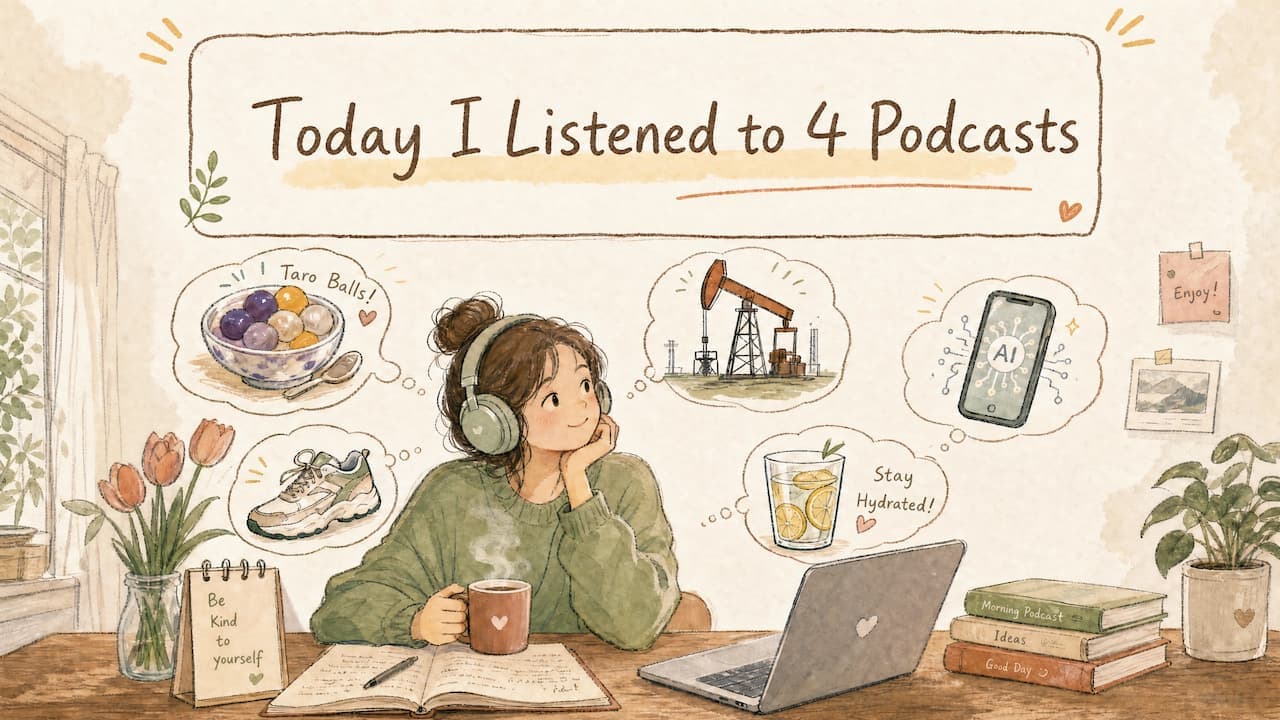
On my morning commute I listened to the usual news podcasts, and in the afternoon, while waiting for car service, I finished a long episode on the history of OPEC. Here is the part worth keeping: Xianyu Xian and the hard problem of scaling dessert chains, Skechers going private, the rise and fracture of OPEC, the absurdity of AI detection, and one small reminder about hydration.
May 25, 2026 · Monday · Morning Notes
The original reason for building this site was simple: if I listen to something, I want to keep something from it.
So I started treating information this way: not as consumption, but as extraction.
This post pulls together notes from three morning news podcasts I listened to today, plus one longer show I played in the afternoon while waiting at a 4S dealership for routine maintenance.
The topics cut across business, technology, history, and everyday health.
I used the AI note-taking agent we are currently building to help organize the material.
Still polishing it, and hopefully we can release it publicly in June.
1. A sweet dessert brand hiding a hard business problem
First, one thing most people probably did not notice: Xianyu Xian has changed owners.
The Chinese dessert chain best known for taro balls and grass jelly was taken over last month by restaurant operator CFB Group. After the acquisition, CFB quickly opened a redesigned store in Shanghai with a brighter space, a simpler menu, and more low-sugar and smaller-size options. The pace was fast, and the direction was clear.
Who is CFB Group? You may not know the name, but you probably know the brand they successfully turned around: DQ.
Back in 2016, DQ in China had seen same-store sales decline for three consecutive years and was stuck in losses. After CFB took over, it spent roughly eight years turning that around into eight straight years of double-digit growth. How? Three moves mattered most:
First, DQ showed up again where younger consumers actually spend attention. Douyin, Xiaohongshu, and Dianping now contribute more than half of DQ sales in China, with a compound annual growth rate above 35 percent. When customers started sharing off-menu combinations on their own, the brand team quickly leaned in and amplified the discussion. When Zootopia 2 became a hot topic, users invented new ways to eat DQ, and the brand turned that into a themed combo within a week.
Second, it applied the logic of new tea chains to ice cream. DQ classic Blizzard products once generated more than 70 percent of sales. Now new products contribute more than 60 percent of annual sales, with around 160 launches a year.
Third, it expanded usage occasions. In 2024, DQ opened its first burger shop in China, turning an ice cream brand into a broader entry point for multiple eating occasions.
So here is the real question: can the same playbook work for Xianyu Xian?
Most observers think the answer is much harder than it was for DQ. The reason is practical.
Ice cream production can be quantified very precisely, from ingredient ratios to temperature control, which makes it naturally suited to chain replication. Chinese dessert soups are different. They rely more on hand preparation, multiple toppings, longer prep time, less stable quality control, and slower service.
The competitive landscape is also more punishing. The barrier to entry is low, and there are already too many rivals. Milk tea brands like Guming and Chabaidao have already added dessert items to their menus. Haidilao launched dessert counters inside hotpot stores earlier this year, starting at 9.9 yuan. Vertical brands like Zhaoji Chuancheng and Maiji Milk are also opening stores aggressively nationwide.
One general manager at Maiji Milk put it bluntly: once a model works in this industry, competitors can copy it within three months.
A commentary from 36Kr made another sharp point: for now, dessert consumption still looks more like an overflow category from milk tea, not an independent and stable occasion of its own.
So the real challenge for Xianyu Xian is not how to open more stores. It is how to make customers feel that if they want dessert, this is the place they specifically need to go. That is a much harder problem.
2. A pair of dad shoes and a 47-year-old founder pushed out of his own company
Another item from today sounded a little bleak at first, but became inspiring once you looked closer.
Aokang International released its annual report, and all of its Skechers franchise stores in China had been cleared out. Many people immediately thought: is Skechers collapsing?
Not really. What disappeared was only the 100-plus stores operated by Aokang. Skechers still has close to 3,500 stores in China across other channels, and business is still running.
But the story is a great entry point into a brand younger consumers jokingly call an old-man shoe. It is a much better story than that label suggests.
In 1992, in California, a 47-year-old man started a footwear company in a rented garage. His name was Robert Greenberg. Before that he had been a barber, a wig-factory owner, and a ski-equipment salesman. At his peak he had founded LA Gear, hired Michael Jackson as an endorser, and built one of the hottest sneaker brands in America. Then, after the peak, the board of his own company pushed him out.
Most people at 47 might have accepted defeat. Greenberg did not. He named the new company Skechers, a Southern California slang term for restless young people. There is something wonderfully stubborn about a middle-aged founder naming his second act after kids who cannot sit still.
His strategy was simple: do not fight Nike and Adidas head-on. Just help ordinary people buy a genuinely comfortable shoe without paying too much.
The early days were rough. The first shoe was too exaggerated in design, distributors returned it en masse, and the company had only three weeks of cash left. Greenberg redesigned it overnight, shortened the tongue, and changed the color to navy blue. He noticed one detail: dockworkers did not want to take their work shoes off after a shift, because they were comfortable. That gave him a lasting insight. What people really wanted was not a more professional performance shoe. It was a comfortable pair they could wear for walking around, dancing, and spending a long day on their feet.
That judgment became the core route of Skechers for the next 30 years.
Then came the famous panda-colored shoe: black and white, on fashion magazine covers, and snapped up by fans. It is still one of the brand most popular products today and tends to come back every few years.
In 2024, Skechers reached $8.97 billion in global sales, up 12.1 percent year over year and a record high. It became the third-largest athletic footwear and apparel brand in the world, behind only Nike and Adidas.
And yet in May 2025, right in the middle of that growth story, Skechers suddenly announced it would go private. Private equity giant 3G Capital bought it at a $9.4 billion valuation, a 30 percent premium.
Why sell when the numbers look this good?
The answer is tariffs. After the United States raised tariffs on Asian supply chains, a pair of Skechers shoes that once sold for a little over 1,100 yuan could end up close to 1,700 yuan at retail. That erodes the core advantage of high value for money. Going private also means less pressure from quarterly reporting and more room to adjust strategy.
The Skechers story reminds me of one sentence: you do not need to be the coolest brand, but you do need to serve the biggest group of people well. Skechers may not be as seductive as Nike, but between Nike and Adidas it built a multi-billion-dollar business on one word: comfort.
In that sense, Skechers choosing privatization under tariff pressure is really an exchange of short-term transparency for long-term strategic flexibility.
3. The rise and decline of OPEC: an ancient problem called alliance
This came from the podcast Path Dependence. For a full hour, it focused on one question: how did OPEC go from being a textbook success in monopoly power to the organization it is today?
What struck me is how similar this history feels to many business stories now.
Act one: oil-producing countries being exploited
Before OPEC existed, Middle Eastern oil was tightly controlled by the multinational oil companies known as the Seven Sisters. They bought oil cheaply, sold it to the world at monopoly prices, and kept the spread. Worse, they set up a dual-pricing mechanism through accounting tricks. The posted price was used to calculate the producer share, but it was far below the real market price, so producer countries received very little income.
Oil producers had suffered under the Seven Sisters for a long time, but fighting alone usually ended badly. Mexico lost its dominance in oil exports after trying to resist. Iran saw the Mossadegh government overthrown after pushing for oil nationalization.
Act two: the power of unity
Then came the key figure: Venezuelan politician Juan Pablo Perez Alfonzo. He pushed the principle of a fifty-fifty split and spent more than a decade persuading oil-producing countries to organize together. In 1960, OPEC was formally founded.
OPEC used the exact opposite strategy from the Seven Sisters. The latter punished any member that tried to stand out. OPEC tried to protect whoever stood out first, holding a united front so that no single country had to stand alone.
In 1973, the oil crisis made OPEC famous overnight. It did not just send oil prices soaring. It also helped oil-producing states in the Middle East achieve nationalization and settle a decades-long historical demand. The Western powers responded by forming the G7.
Act three: internal conflict empties out the alliance
But once the common enemy disappeared, the internal contradictions of OPEC started surfacing.
By the 21st century, OPEC control over member output had become almost symbolic. Members quietly exceeded quotas, and production limits existed largely on paper. More recently, the United Arab Emirates announced its exit from OPEC, which many people took as a sign of the organization entering twilight.
But the podcast offered a deeper insight: the UAE did not leave mainly because its quota was too low. It left because the quotas no longer constrained it in practice. The deeper reason was a new peak in its struggle with Saudi Arabia for leadership in the Arab world.
Saudi Arabia has long been the dominant force inside OPEC, and the UAE does not accept that quietly. During the Iran-related regional turmoil, the Arab world took heavy damage while Saudi Arabia failed to act decisively, which deepened UAE dissatisfaction. Leaving OPEC was the first public step in openly breaking with Saudi Arabia.
What begins for one reason often ends for that same reason. That line from Zuo Zhuan was also the conclusion of the episode.
OPEC rose because of unity and declined because of infighting. That pattern applies not just to states, but to almost any organization or partnership.
| Phase | Period | Key event | Result |
|---|---|---|---|
| Oppressed stage | 1900s-1950s | Seven Sisters monopoly exploits producer nations | Producer income stays extremely low |
| Collective rise | 1960-1973 | OPEC founded and oil crisis erupts | Pricing power returns and oil is nationalized |
| Peak and fracture | 1973-2000s | Members overproduce and quotas lose force | Organization becomes hollowed out |
| Twilight | 2020s to now | UAE exits and rivalry with Saudi Arabia intensifies | OPEC becomes nominal more than real |
4. AI is doing two opposite things at once: getting cheaper and making people act dumber
Two AI news items today felt especially interesting when placed next to each other.
First: DeepSeek announced a permanent API price cut, lowering output cost to just 6 yuan per million tokens.
What does that mean? The compute cost of large models is falling at astonishing speed. The age of broadly affordable AI is not about to arrive. It is already here.
Second: the essay Moonlight over the Lotus Pond by Zhu Ziqing was flagged by an AI detector as more than 60 percent AI-generated, and some handwritten student papers were rated as high as 80 percent AI.
The absurd part is that students, in order to avoid being flagged, are being pushed to deliberately write in a dumber way. They sacrifice logic and fluent expression. The more natural and readable the prose sounds, the more likely it is to be labeled AI-generated.
That creates a paradox worth sitting with: as machines become more human-like, people have to act less human-like to prove they are human.
AI detectors essentially use statistical patterns to judge whether a text was written by a person. But good writing naturally has patterns. Clear logic and fluent expression are exactly what education is supposed to cultivate. If those goals now conflict with proving that a student is human, what exactly are we protecting?
5. Summer is here, and you may really not be drinking enough water
One health topic from Info Morning at Seven today focused on a very ordinary question: how should we drink water in summer?
It sounds basic, but some details are easier to overlook than you think.
Not drinking enough water does not only make you thirsty. It also raises the risk of gout, kidney stones, constipation, and obesity, and may even significantly increase the risk of cognitive decline. Adult men need at least 1,700 milliliters a day, while women need 1,500 milliliters.
Besides plain water, these are also reasonable choices:
| Drink | Feature | Good for |
|---|---|---|
| Light green tea | Can directly substitute for water | Daily hydration |
| Fresh lemon water | Better with sliced fresh lemons than concentrate | Afternoon refresh |
| Passion fruit water | High in vitamin C and potassium, helpful for blood pressure control | After exercise |
| Goji berry water | Lightly sweet, but do not expect miracle nutrition claims | Everyday drinking |
| Mung bean soup | Cools the body and helps replace what sweating takes away | Hot summer days |
| Light vegetable soup | Low oil and low salt, easy to hydrate during meals | With daily meals |
Sugary drinks deserve special attention. A Zhejiang University School of Medicine study covering more than 170,000 people found that higher sugary-drink intake was associated with higher dementia risk. A Tsinghua University study found that people who drank more than one bottle of sugary beverages a day had a hair-loss risk 2.36 times higher than people who did not.
Even more surprising: sugar-free drinks are not ideal as a daily habit either. The latest World Health Organization guidance states clearly that replacing sugar with sweeteners does not help control body weight and may instead raise the risk of type 2 diabetes and cardiovascular disease.
So yes, this summer, drink more water.
What stayed with me today
Across these four podcasts, the word that stayed with me most was boundary.
Xianyu Xian is asking where the boundary of dessert really is, and how to make it feel like an independent occasion instead of a milk tea substitute. Skechers is asking where the boundary of affordability lies, and whether that edge can survive tariffs. OPEC declined because members kept crossing the boundary of agreed quotas until the organization itself lost meaning. AI detectors are trying to redraw the boundary of human writing, only to produce an absurd result.
A lot of the time, what looks like a fight over resources is really a fight over who gets to define the boundary.
This post is based on podcast episodes from May 25, 2025, including Shengdong Morning Coffee, Moyu Morning Report, Info Morning at Seven, and one May 24 episode of Path Dependence.
If you also learn through podcasts, try XYZ Podcast Downloader. We are still building the next layer of transcription, summarization, highlight, and sharing tools.
If this was useful, feel free to send it to one friend who might enjoy it too.